Anyword vs ChatGPT: Which Is Better?
Compare Anyword and ChatGPT for marketing copy, performance prediction, brand control, general business work, pricing, and team fit.
Direct answer
Anyword is better for a marketing team that specifically needs brand-controlled copy, performance predictions, campaign templates, and content intelligence. ChatGPT is better for a team that needs one general AI workspace across writing, research, analysis, files, coding, planning, and company knowledge.
The products overlap in copy generation, but they are not direct substitutes in every workflow. Anyword is a specialist performance-writing platform. ChatGPT is a general-purpose assistant. The right choice depends on whether marketing optimization is the primary job or one of many jobs.
This comparison is based on official sources checked on August 7, 2026. We did not run controlled output tests, validate Anyword’s prediction accuracy, or compare conversion results. Product claims below are documented facts; recommendations are editorial inferences from those facts.
Anyword vs ChatGPT at a glance
| Decision area | Anyword | ChatGPT |
|---|---|---|
| Best fit | Performance-oriented marketing content | General AI work across business functions |
| Core workflow | Generate, improve, score, and analyze marketing copy | Converse, research, analyze files, write, code, and work with company context |
| Brand controls | Brand voices, audiences, vocabulary, messaging bank, and formulas | Workspace instructions, projects, company knowledge, and custom workflows vary by plan |
| Performance layer | Predictive scores, performance data rows, content intelligence | No equivalent Anyword-style marketing prediction system documented |
| Entry pricing checked | Starter: $49 monthly or $39 monthly billed annually | Business pricing and seat terms vary by region and current plan rules |
| Main limitation | Narrower than a general assistant | Less specialized for predictive marketing-copy workflows |
Prices are public US values where available and can change. Taxes, promotions, regional pricing, annual commitments, credits, and add-ons may affect the final bill.
The central difference: specialist versus generalist
Anyword organizes its product around a marketing production loop: define brand context, create content, predict likely performance, connect channel data, and use what has worked before to guide future copy. Its official documentation centers concepts such as Brand Voice, Predictive Scores, performance data rows, Blog Wizard, templates, and Content Intelligence.
ChatGPT is organized around a broader workspace. OpenAI documents writing, analysis, file work, projects, apps, company knowledge, administration, and other capabilities that vary by plan. Marketing copy is one valid use, but it is not the entire product model.
This difference matters because specialist software should earn its place. If a company only needs occasional captions, emails, and drafts, a general assistant may cover the job. If a marketing team needs repeatable brand controls and a performance-data workflow, Anyword has a clearer specialist case.
Where Anyword is stronger
Marketing-specific structure
Anyword’s official pricing page lists more than 100 marketing templates and prompts, a Blog Wizard, a data-driven editor, performance-driven templates, and a content improver. The platform is therefore structured around common marketing outputs rather than an open-ended chat alone.
That can reduce setup work for marketers who repeatedly create ads, landing-page copy, email content, social posts, and blog material. The advantage is not that a template guarantees better copy. It is that the workflow starts closer to the task.
Brand context
Anyword’s Brand Voice documentation describes tone of voice, target audiences, vocabulary, formatting rules, and other reusable brand elements. Its pricing table also distinguishes the number of brand voices available by plan.
For a team managing multiple brands or strict messaging rules, this is more explicit than relying on a prompt document that every user must remember to attach. The limitation is still governance: someone must maintain the brand context and review whether generated copy actually follows it.
Performance predictions and content intelligence
Anyword defines performance predictions as estimates of how likely copy is to engage or convert. It also describes performance data rows as metrics collected through integrations and used to improve prediction and generation workflows.
This is Anyword’s clearest differentiator. ChatGPT does not document an equivalent built-in marketing-copy prediction layer. However, buyers should not confuse a prediction with a guaranteed business result. Prediction quality depends on the data, use case, and model. A controlled test in the buyer’s own channels remains necessary.
Where ChatGPT is stronger
Breadth of work
ChatGPT is the stronger choice when marketing is only part of the requirement. A small team may use the same workspace for campaign planning, spreadsheet analysis, document summaries, customer research, coding support, operations, internal knowledge, and writing.
That breadth can reduce tool sprawl. It can also make governance harder because a general assistant invites more use cases, more data types, and more questions about approval. The buyer should define allowed workflows before rollout.
Cross-functional collaboration
OpenAI positions ChatGPT Business as a collaborative workspace with administration, billing, privacy commitments, and company context. Official guidance states that Business workspace data is excluded from training by default and encrypted in transit and at rest.
For a company that wants one managed AI environment across several functions, this can be more valuable than a marketing-only platform. A marketing team should still check whether its specialist needs are covered before assuming breadth equals fit.
Research and analysis
ChatGPT supports work that happens before and after copy generation: analyzing files, synthesizing information, planning experiments, organizing evidence, and exploring alternatives. Anyword may assist with research inside its marketing workflow, but its official positioning is more concentrated on performance writing.
Pricing and commitment
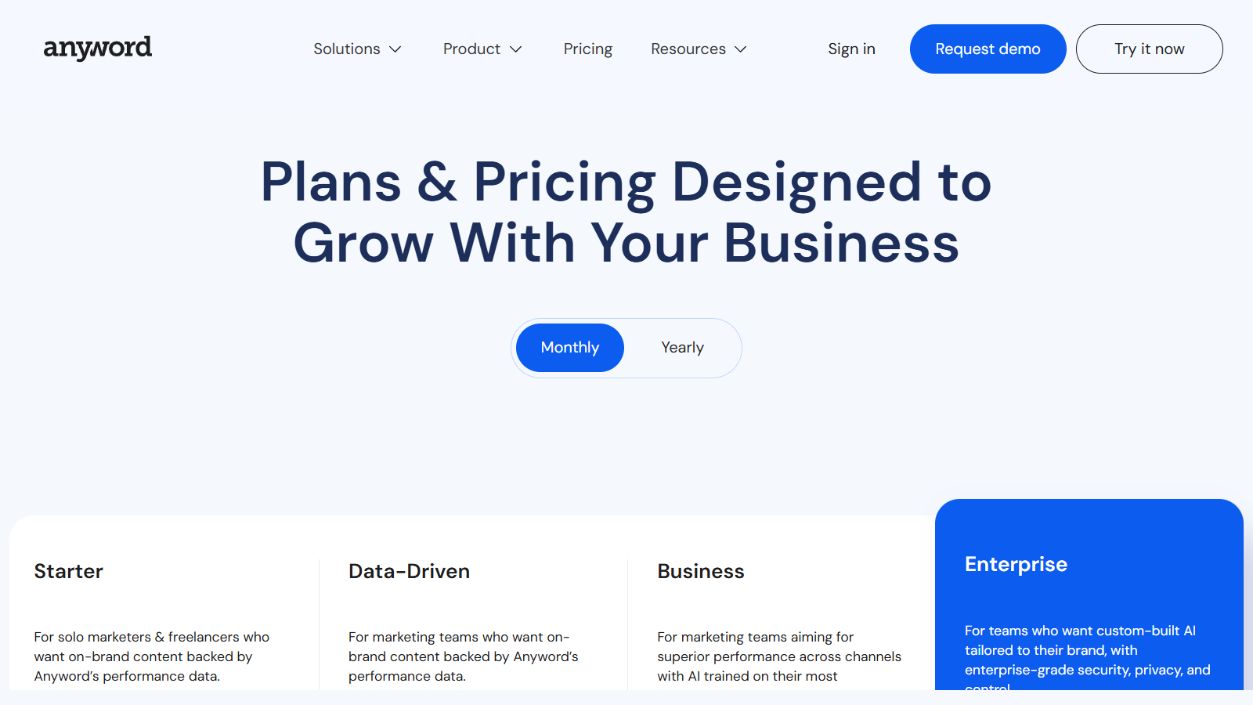
Anyword’s pricing page showed the following when checked:
- Starter: $49 per month, or $39 per month billed annually; one seat.
- Data-Driven: $99 per month, or $79 per month billed annually; three seats included.
- Business: custom pricing; three seats listed, with marketing intelligence and custom-model capabilities.
- Enterprise: custom pricing, with enterprise controls and custom integrations.
Starter and Data-Driven include unlimited generated words, but prediction counts, data rows, seats, workspaces, and brand voices are limited by plan. Anyword also describes a seven-day trial with a word limit.
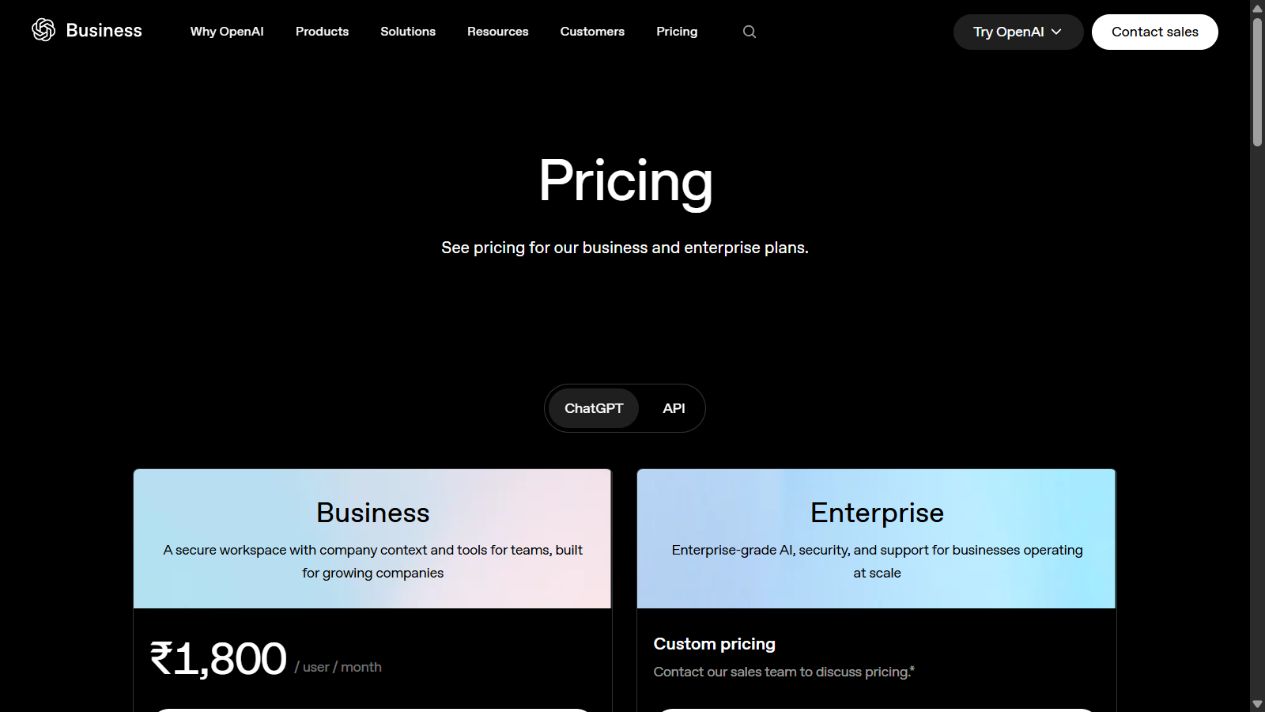
ChatGPT pricing should be checked directly at purchase because OpenAI changed Business plan and seat details in 2026. The cost comparison is therefore not only headline price. Compare minimum seats, annual commitment, specialist limits, and whether another general AI subscription already exists.
Which tool should each buyer choose?
Choose Anyword when
- marketing copy is a high-volume, recurring workflow;
- brand voices and audience definitions need centralized structure;
- the team wants to connect campaign performance data to content production;
- predictive scoring is valuable enough to test against actual outcomes;
- a specialist marketing tool has a clear owner and success metric.
Choose ChatGPT when
- one AI workspace must support several departments;
- research, file analysis, planning, or coding matter alongside writing;
- the business wants to reduce overlapping AI subscriptions;
- marketing volume is not high enough to justify a specialist platform;
- the team can define acceptable-use and review controls.
Consider both only when
The company already gets measurable value from a general AI workspace and has a separate, recurring marketing-copy workflow that Anyword improves. Do not buy both simply to compare outputs. Define a test where Anyword’s brand and performance layer must produce a measurable operational or campaign benefit.
A fair pilot plan
Run the same four-week test for either product:
- Choose one channel, such as paid social ads or lifecycle email.
- Create a fixed brief, audience, offer, brand rules, and approval standard.
- Record current production time and revision count.
- Produce a controlled set of variants.
- Review factual accuracy, brand fit, editing effort, and approval speed.
- Publish only approved variants through the normal campaign process.
- Compare real channel results without attributing every change to the AI tool.
For Anyword, compare predictive guidance with actual outcomes. For ChatGPT, measure whether broader research and planning reduce total campaign effort. The test should evaluate the workflow, not just which first draft sounds better.
Common buying mistakes
Treating predicted performance as proof
Anyword’s prediction layer is a decision aid, not a guaranteed conversion result. Keep experiments controlled and retain human review.
Buying a specialist before defining volume
A specialist platform is difficult to justify when the team creates only a few marketing assets each month. Estimate usage before adding another subscription.
Ignoring data governance
Marketing teams handle customer lists, campaign data, unpublished offers, and brand material. Review vendor terms and internal policy before connecting sensitive systems.
Comparing output without comparing editing effort
The useful metric is not the number of words generated. Track time to an approved asset, revision count, factual corrections, and campaign impact.
Related guides
Use our AI writing tool selection guide to define requirements before a trial. The AI tools evaluation guide covers evidence, governance, and pilot design. Teams automating campaign handoffs should also review marketing automation workflow planning, our best AI tools for small businesses, and the AI governance checklist for business teams.
Official sources checked
- Anyword pricing and plan comparison
- Anyword Knowledge Base
- Anyword Brand Voice documentation
- OpenAI: What is ChatGPT Business?
- OpenAI: Business data privacy, security, and compliance
- OpenAI: Managing data, sharing, and privacy in ChatGPT Business
Verdict
Choose Anyword when marketing performance workflows, reusable brand controls, and content intelligence are the reason for the purchase. Choose ChatGPT when the company needs a broader AI workspace and marketing copy is one of several jobs.
For most small teams, ChatGPT is the more versatile first tool. Anyword should be the deliberate second purchase when its specialist workflow can be tested against a clear marketing objective.
Frequently asked questions
Is Anyword better than ChatGPT for marketing copy?
Anyword is the more specialized choice when a marketing team needs structured brand voices, performance predictions, marketing templates, and content intelligence. ChatGPT is the broader choice for research, analysis, writing, files, coding, and general business work.
Can Anyword replace ChatGPT?
Only for a narrow marketing workflow. Anyword can cover campaign copy and performance-oriented content work, but it is not positioned as a general assistant across research, analysis, coding, and company knowledge.
Which tool is better for a small business?
ChatGPT is usually the more versatile first purchase. Anyword becomes more compelling when repeatable marketing copy, brand governance, and performance-oriented workflows are important enough to justify a specialist tool.
Did The SaaS Education test Anyword and ChatGPT hands-on?
No. This comparison uses official sources checked on August 7, 2026 and clearly separates documented facts from editorial conclusions.